Developers / batch video background removal
How to automate batch video background removal with webhooks
Design a reliable batch-processing pipeline with direct uploads, controlled concurrency, idempotent webhooks, retries, job state, and quality sampling.
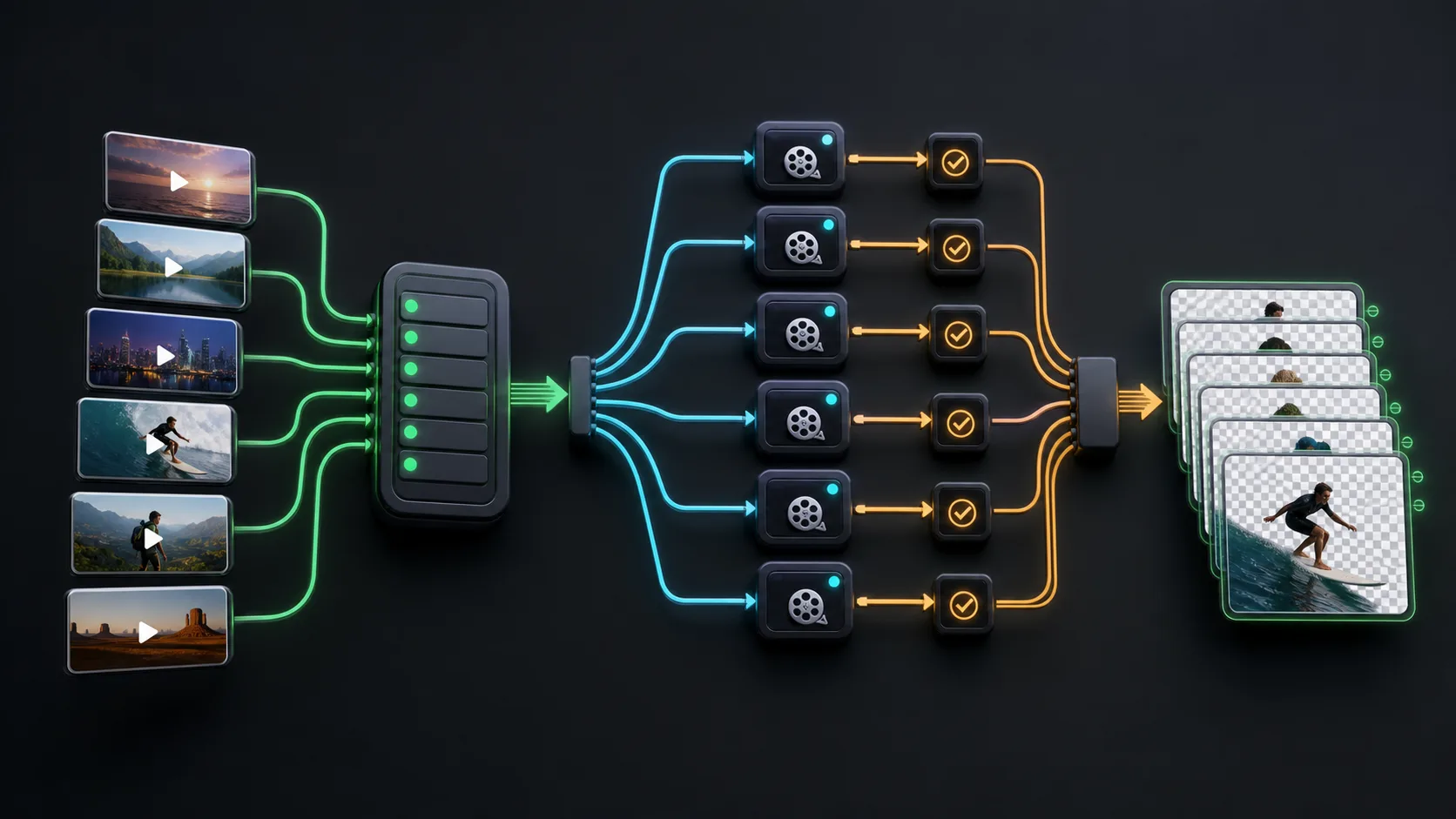
The useful answer
Model every video as an independent state machine, limit concurrency, verify and deduplicate webhook deliveries, persist terminal results, and make retries safe instead of assuming jobs finish once and in order.
Review the API workflowDecision map
From source clip to useful output
Define the destination
Decide where “batch video background removal” must work before choosing a format or background.
Protect the moving edge
Review hair, hands, motion blur, and every place the subject crosses another object.
Test the real delivery
Open the result in the actual browser, editor, presentation, or social workflow.
A batch pipeline turns a one-video API tutorial into an operational system. Files arrive at different sizes, processing completes out of order, webhooks may be delayed or repeated, and a small percentage of clips will need review. Reliability comes from explicit state, not from a longer loop.
Use one state machine per video
created -> uploading -> submitted -> queued
queued -> processing -> encoding -> completed
uploading | submitted | queued | processing | encoding -> failed
failed -> retry_scheduled -> submitted
Store your internal asset ID, Backdrop upload ID, job ID, desired output, attempt count, timestamps, and terminal result metadata. Do not infer truth from the last UI action; reconcile against the processing job.
Control concurrency at submission
- Upload directly with signed URLs rather than proxying every byte through one application server.
- Submit a limited number of new jobs at once and increase only after measuring throughput and failure behavior.
- Separate upload concurrency from processing concurrency because their bottlenecks differ.
- Use per-customer or per-project limits so one large batch cannot starve interactive work.
Make webhook handling idempotent
- 01
Verify authenticity
Validate the webhook signature using the documented raw-body procedure before trusting fields.
- 02
Record the delivery
Persist a stable event or delivery identifier when the webhook contract provides one.
- 03
Apply a guarded transition
Update the matching job only if the new state is valid and not older than known state.
- 04
Respond quickly
Acknowledge receipt, then perform downloads, notifications, and downstream work asynchronously.
- 05
Accept repetition
A duplicate delivery should produce the same stored result and no duplicate customer action.
Retry the operation, not the uncertainty
Before resubmitting a timed-out request, check whether a job was already created. Use your own idempotency key or stable mapping where the API supports it. Retry transient transport and service failures with exponential backoff and jitter. Do not retry invalid inputs, insufficient credits, or permanent format errors until something changes.
Download finished assets safely
When completion arrives, enqueue a separate result-ingestion task. Download from the signed URL, verify the response and expected media type, store the asset in your system, and record a checksum when duplicate detection matters. Acknowledge the webhook even if downstream delivery to another service will take time.
Sample quality instead of pretending automation is perfect
- Review a percentage of every batch over light and dark backgrounds.
- Route low-light, heavy-motion, multi-person, and prop-heavy clips to a higher review tier.
- Record failure reasons in structured categories, not only free-text logs.
- Keep original inputs long enough to reproduce important failures under the agreed retention policy.
Sources and further reading
Frequently asked questions
Can webhooks be delivered more than once?
Yes. Design the handler so duplicate delivery produces the same stored state without duplicate downloads, notifications, or billing actions.
How many videos should I process concurrently?
Start with a conservative application limit, measure upload and processing behavior, and increase gradually. Separate limits by customer and by pipeline stage.
What should happen if a webhook is missed?
Run a reconciliation process that checks non-terminal jobs against the API. Webhooks should accelerate updates, not become the only way your system can discover completion.
Quality gate
Three surfaces reveal different edge problems
Light background
Look for dark contamination, clipped hair, and hard matte boundaries.
Dark background
Look for pale halos, spill, and semitransparent noise around motion.
Final destination
Confirm playback, dimensions, compression, and transparency where viewers will see it.
Design against duplicate and delayed events
Use the API reference to map upload, job, webhook, and result states before sending the first production batch.
Review the API workflow